Aikido is a Japanese martial art that teaches self-defense and how to manage conflict situations through exercises with weapons and empty hands.
Aikido is intended for anyone with good intentions who wishes to learn an authentic, non-competitive martial art.
What equipment should be brought ?
For the first sessions, you can wear loose-fitting pants and a shirt to allow free movement.
Wooden weapons (Bokken and Jo) are available at the dojo.
Students who wish can later obtain the training jacket, training pants (Keiko-gi), and a set of wooden weapons (Bokken and Jo) from the instructor.
What physical skills are developed ?
The execution of techniques emphasizes flexibility and joint strengthening.
Movement exercises aim to improve balance, posture, and mastery of the center of gravity.
What other qualities does Aikido help develop ?
Respect for one’s training partner (adapting one’s level to that of the other).
Development of self-confidence in conflict situations while maintaining calm.
Promotion of a group spirit: each practitioner demonstrates kindness and works with all others.
What are the goals of learning Aikido ?
Learning to protect oneself and loved ones in various situations (such as falls, obstacles, or pushes).
Not opposing an aggression but rather evading or absorbing it.
Gradually acquiring an understanding of the principles underlying all techniques of Aikido, which can be applied in daily life.
Transmitting the teachings of Aikido’s founder, Morihei Ueshiba.
What does a typical session look like ?
The session begins with a traditional opening bow to the instructor in SEIZA (sitting on the knees).
It continues with TAISO practice, which consists of individual warm-up exercises to acquire the basic movements of Aïkido, such as footwork and rolls.
Then, students move on to KIHON practice, where they work on basic techniques applied to empty-hand or wooden weapon grabs.
The session ends with a traditional closing bow to the instructor in SEIZA.
What does progression look like throughout the session?
Progression occurs primarily through the execution and mastery of increasingly advanced exercises and techniques.
This progression is recognized by the issuance of a KYU (grade for beginners), corresponding to a colored belt (yellow, orange, green, blue, brown, and black), with the black belt representing the 1st DAN (advanced grade).
Evaluation criteria differ between adults and children:
For children, three main criteria are considered: attendance, concentration, and execution of an exercise.
For adults (beginner level), it is necessary to demonstrate knowledge of basic empty-hand and weapon techniques (a defined program) through five exams corresponding to KYU grades (from yellow to brown).
The awarding of a grade typically occurs at the end of a school year (three sessions) and depends on the progression and attendance of each practitioner.
Once a practitioner has achieved the five Kyu, they can take the exam for the 1st Dan grade (black belt).
« Memoir of the Master » was first published in Kisshomaru Ueshiba’s 1963 book « Aikido ». The English translation — slightly modified here — was based on Kisshomaru Ueshiba’s 1962 Japanese book « Aikido Giho ». This text is provided for those who wish to choose from among these maxims of the Founder to produce inspirational images and posters embodying the essential philosophy of Morihei Ueshiba.
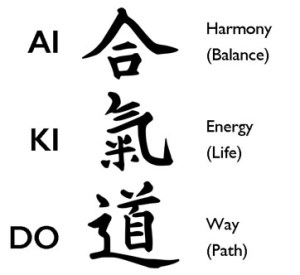
As AI (harmony) is common with AI (love), I decided to name my unique budo « Aikido, » although the word « Aiki » is an old one. The word which was used by the warriors in the past is fundamentally different from that of mine.
Aiki is not a technique to fight with or defeat the enemy. It is the way to reconcile the world and make human beings one family.
The secret of Aikido is to harmonize ourselves with the movement of the universe and bring ourselves into accord with the universe itself. He who has gained the secret of Aikido has the universe in himself and can say, « I am the universe. » I am never defeated, however fast the enemy may attack. It is not because my technique is faster than that of the enemy. It is not a question of speed. The fight is finished before it is begun.
When an enemy tries to fight with me, the universe itself, he has to break the harmony of the universe. Hence at the moment he has the mind to fight with me, he is already defeated. There exists no measure of time — fast or slow.
Aikido is non-resistance. As it is non-resistant, it is always victorious.
Those who have a warped mind, a mind of discord, have been defeated from the beginning.
Then, how can you straighten your warped mind, purify your heart, and be harmonized with the activities of all things in Nature? You should first make the kami’s heart yours. It is a Great love, omnipresent in all quarters and in all times of the universe.
There is no discord in love. There is no enemy of love. A mind of discord, thinking of the existence of an enemy is no more consistent with the will of the kami.
Those who do not agree with this cannot be in harmony with the universe. Their budo is that of destruction. It is not constructive budo..
Therefore to compete in techniques, winning and losing, is not true budo. True budo knows no defeat. « Never defeated » means « never fighting. »
Winning means winning over the mind of discord in yourself. It is to accomplish your bestowed mission.
This is not mere theory. You practice it. Then you will accept the great power of oneness with Nature.
Don’t look at the opponent’s eyes, or your mind will be drawn into his eyes. Don’t look at his sword, or you will be slain with his sword. Don’t look at him, or your spirit will be distracted. True budo is the cultivation of attraction with which to draw the whole opponent to you. All I have to do is keep standing this way.
Even standing with my back toward the opponent is enough. When he attacks, hitting, he will injure himself with his own intention to hit. I am one with the universe and I am nothing else. When I stand, he will be drawn to me. There is no time and space before Ueshiba of Aikido — only the universe as it is.
There is no enemy for Ueshiba of Aikido. You are mistaken if you think that budo means to have opponents and enemies and to be strong and fell them. There are neither opponents nor enemies for true budo. True budo is to be one with the universe; that is to be united with the Center of the universe.
A mind to serve for the peace of all human beings in the world is needed in Aikido, and not the mind of one who wishes to be strong or who practices only to fell an opponent.
When I am asked if my Aiki budo principles are taken from religion, I say « No. » My true budo principles enlighten religions and lead them to completion.
I am calm however and whenever I am attacked. I have no attachment to life or death. I leave everything as it is to the kami. Be apart from attachment to life and death and have a mind which leaves everything to Him, not only when you are being attacked but also in your daily lives.
True budo is a work of love. It is a work of giving life to all beings, and not killing or struggling with each other. Love is the guardian deity of everything. Nothing can exist without it. Aikido is the realization of love.
I do not make a companion of men. Whom, then, do I make a companion of? The kami. This world is not going well because people make companions of each other, saying and doing foolish things. Good and evil beings are all one united family in the world. Aikido leaves out any attachment. Aikido does not call relative affairs good or evil. Aikido keeps all beings in constant growth and development and serves for the completion of the universe.
In Aikido we control the opponent’s mind before we face him. That is how we draw him into ourselves. We go forward in life with this attraction of our spirit, and attempt to command a whole view of the world. We ceaselessly pray that fights do not occur. For this reason we strictly prohibit matches in Aikido. Aikido’s spirit is that of loving attack and that of peaceful reconciliation. In this aim we bring and unite the opponents with the will power of love. By love we are able to purify others.
Understand Aikido first as budo and then as the way of service to construct the World Family. Aikido is not for a single country or anyone in particular. Its only purpose is to perform the work of the kami.
True budo is the loving protection of all beings with a spirit of reconciliation. Reconciliation means to allow the completion of everyone’s mission.
The « Way » means to be one with the will of the kami and practice it. If we are even slightly apart from it, it is no longer the Way.
We can say that Aikido is a way to sweep away devils with the sincerity of our breath instead of a sword. That is to say, to turn the devil-minded world into the World of Spirit. This is the mission of Aikido.
The devil-mind will go down in defeat and the Spirit rise up in victory. Then Aikido will bear fruit in this world.
Without budo a nation goes to ruin, because budo is the life of loving protection and is the source of the activities of science.
Those who seek to study Aikido should open their minds, listen to the sincerity of the kami through Aikido, and practice it. You should understand the great ablution of Aiki, practice it and improve without hinderance. Willingly begin the cultivation of your spirit.
I want considerate people to listen to the voice of Aikido. It is not for correcting others; it is for correcting your own mind. This is Aikido. This is the mission of Aikido and should be your mission.
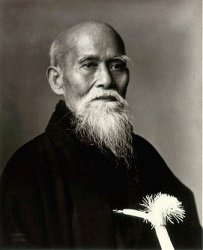
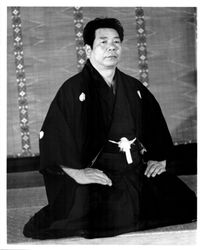
MORIHEI UESHIBA was born in 1883 and passed away in 1969. He was the master and the creator of Aïkido, a traditional martial art that is derived from Aiki-jutsu whose most ancient techniques date back to nearly seven hundred years ago.
According to some, Aiki-jutsu dated from KAMAKURA time (1166-1333), one of the most brilliant eras of Japanese history. It was founded by MINAMOTO YOSHIMITSU and transmitted from generation to generation in the MINAMOTO family, a well-known line in Japan, then to the TAKEDA family.
After seven generations, the legitimate heir was the master MORIHEI UESHIBA who assimilated these ancient techniques to arrive at what is currently known as Aïkido.
The founder defined his Art as the manifestation of TAKEMUSU. Today, Aikido Takemusu defines its practice by its faithfulness to the authentic origin of this art.
The Master MORIHEI UESHIBA studied many martial arts like KENDO (Japanese fencing), JU JUTSU (ancestor of JUDO) and SO-JUTSU (spear). As early as 1915, he deepened his studies in the techniques of Daito school under the direction of the master SOKAKU TAKEDA. These techniques contained many of the aiki jutsu movements.
After that, master UESHIBA created his own school and taught Aikido. This art remained secret for a long time: his teaching was only authorized for a military elite and a privileged few.
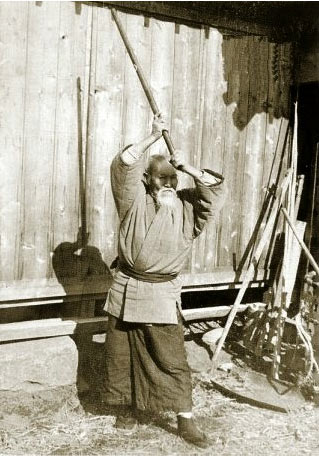
Morihiro Saito
In 1941, he permanently left Tokyo and settled with his family in IWAMA where during the last 29 years of his life, the founder of Aikido developed and deepened his art among some farmers, very far from the “So Hombu Aikikai World Center” of Tokyo.
During this important post-war period, the founder gradually ascended to his highest and deepest expression of his Art, developing whole sections of Aikido, including BUKIWAZA, the work of weapons according to AIKI principle which was only embryonic before the war.
TAKEMUSU is a manifestation of that will and the only Uchi Deshi who lived during that period was Master MORIHIRO SAITO who was born on 31 March in 1928 and passed away on 13 May in 2002.
What does Aïkido bring from a physical and mental perspective?
Most of this wonderful discipline lies in the mind, making it an artistic and spiritual practice. In fact, Aikido techniques are dissociated from any violent means. All enmity disappears to make room for an elegant and a worthy mastery.
Opponents’ attacks are smoothly deflected, however, without energy being destroyed. Then the movement is driven to a position which removes any efficiency of the adversary.
At the top level of the practice, it is also controlling the mind of the adversary, at the initial source of his action.
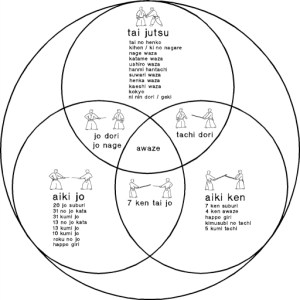
Besides the techniques of bare hands, Aikido develops the BUKIWAZA in depth, the practice of sword and spear, traditional weapons of the Japanese aristocratic class of the Samurai.
From a self-defense perspective
Place the aggressor in a painful and non-functional position to stop his effectiveness. An effective control of body joints and nerve centers. Control of armed opponents.
Equipments for practice
Aikido is practiced in white KEIKO GI (judo jacket and trousers) and HAKAMA (Japanese traditional trousers – be worn after certain time of practice). A BOKKEN (wooden sword) and a JO (wooden spear) are also necessary for Aikido practices.
For moving from the dressing room and the dojo, the practitioners will wear ZOORIS (sandals). A strict body hygiene is to be respected.
Qu’apporte l’AIKIDO du point de vue physique et mentale?
L’essentiel de cette discipline magnifique réside dans l’état d’esprit, ce qui en fait une culture artistique et spirituelle. En fait, les techniques d’Aikido se dissocient de tous les moyens violents. Toute inimité disparaît pour faire place à une maîtrise d’élégance et de dignité.
Les attaques des adversaires sont déviées souplement sans que, pour autant, l’énergie en soi détruite. Alors le mouvement est conduit jusqu’à une position qui empêche toute efficacité de l’adversaire.
Au niveau supérieur, il s’agit également de contrôler l’esprit de l’adversaire, source initiale de son action.
Outre les techniques à mains nues, l’Aikido développe de manière approfondie le BUKIWAZA, la pratique du sabre et de la lance, armes traditionnelles de la classe aristocratique japonaise des Samouraïs
Du point de vue auto-défense
Placer l’agresseur dans une position douloureuse et non-fonctionnelle qui empêche son efficacité. Contrôle redoutable des articulations et centre nerveux du corps. Contrôle d’adversaires armés.
Équipement pour pratiquer
L’Aikido se pratique en KEIKO GI (veste et pantalon de judo) blanc et HAKAMA (pantalon traditionnel japonais – se porte après un certain temps de pratique). Un BOKKEN (sabre en bois) et un JO (lance en bois) sont également nécessaires pour la pratique de l’Aikido.
Pour le déplacement entre le vestiaire et le dojo, les pratiquants porteront des ZOORIS (sandales). Une hygiène corporelle stricte est à respecter.
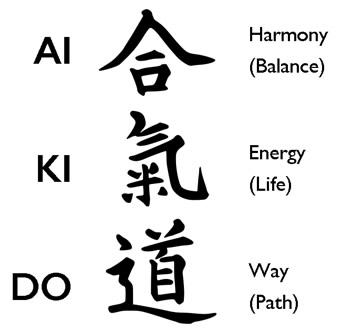
Fondé par Morihei Ueshiba O’sensei entre 1925 et 1969, l’Aïkido (合気道) est un art martial japonais (Budo) issu de l’aiki-jutsu, un art martial ancestral pratiqué par les samouraïs et dont les techniques les plus anciennes remontent à près de sept cents ans.
L’aiki-jutsu daterait, selon certains, de l’époque Kamakura (1166-1333), l’une des plus brillantes de l’histoire du Japon. Il aurait été fondé par le samouraï Minamoto Yoshimitsu et transmis, de génération en génération, à la famille Minamoto, fort célèbre au Japon, puis à la famille Takeda.
Au terme de sept générations, l’héritier légitime fut Maître Morihei Ueshiba qui assimila ces techniques ancestrales pour arriver à ce que l’on nommera actuellement l’Aïkido.
Le fondateur définissait son Art comme la manifestation du Takemusu. Aujourd’hui, l’Aikido Takemusu définit la pratique la plus fidèle et authentique de cet art.
Maître Morihei Ueshiba étudia de nombreux arts martiaux comme l’escrime japonaise (Kendo), le Ju-Jutsu (ancêtre de Judo) et la lance (So-Jutsu). Il approfondit dès 1915 l’étude des techniques de l’école Daito (Daitōryū) sous la direction de maitre Sokaku Takeda, dont les techniques comportaient de nombreux mouvements d’aiki-jūjutsu.
Après avoir reçu son enseignement, maître Ueshiba créa sa propre école et y enseigna l’Aïkido. Cet art resta longtemps secret, son étude n’étant autorisée que pour une élite militaire ainsi qu’à de rares privilégiés.
Morihiro Saito
En 1941, il quitta définitivement Tokyo et s’installa, avec sa famille, à Iwama où pendant les 29 dernières années de sa vie, le Fondateur de l’Aïkido développa et approfondit son Art parmi quelques paysans, bien loin du « Centre Mondial Aïkikai So Hombu » de Tokyo.
Durant la période capitale de l’après-guerre, le Fondateur accéda progressivement à la plénitude de son Art, en développant des pans entiers de l’Aïkido, dont le travail des armes (Bukiwaza) selon le principe Aïki qui n’était qu’embryonnaire avant la guerre.
Takemusu est une manifestation de cette volonté et le seul Uchi Deshi qui vécut cette période fut Maître Morihiro Saito, né le 31 mars 1928 et décédé le 13 mai 2002.
AIKI. Le terme AIKI existe depuis très longtemps. Le AI d’Aïkido est un homophone de AI ⇒ Aimer. La voie particulière que j’ai parcourue et conquise et dont je me suis imprégné, je l’ai nommée AIKI-DO. Ce que les gens, qui pratiquant les arts martiaux, appellent AIKI est fondamentalement différent de ce que je nomme AIKI…
AIKI n’est pas l’art de la bataille avec l’ennemi ; ce n’est pas une technique de destruction de l’adversaire, c’est la voie de l’harmonisation de monde qui fait de l’humanité une seule maison.
L’Aïkido est l’art martial de Vérité, c’est un acte d’Amour, c’est la voie de sauvegarde de tous les êtres vivants, c’est le compas qui fait vivre toutes choses ; c’est la manifestation de TAKEMUSU qui jusqu’à nos jours a donné naissance aux techniques des arts martiaux. Le Bu qui nait de TAKEMUSU se conforme à la loi d’apparition et de développement de toute la création. C’est la Loi qui protège la croissance de toutes choses.
Si l’on peut dire que L’Aiki est le Budo de la vérité, c’est parce qu’il est issu de l’ordre de l’Univers. Cet Univers s’est divisé à partir de l’UNITÉ. L’Univers tout entier s’harmonise comme une seule Maison et se présente comme la perfection et la paix. L’AÏKIDO qui s’enracine dans une telle conception ne peut être que le Budo d’amour et ne peut dont pas être le Bu de violence.
L’AÏKIDO est MASAKATSU, AGATSU, KATSU HAYAHI.
MASAKATSU, c’est vaincre la Vérité
AGATSU, c’est complètement réussir la mission que le ciel nous a donnée
KATSU HAYAHI, c’est l’ardeur, l’enthousiasme, qui permet de vaincre le Temps.
Je peux tourner le dos à l’adversaire ; quand l’adversaire m’attaque, il se frappe par sa propre volonté de m’attaquer. Je suis UN avec l’Univers. Je ne suis rien. Quand je suis là, l’adversaire est aspiré. Dans l’aikido d’Ueshiba, il n’y a ni temps, ni espace, il n’y a que l’Univers. C’est cela KATSUHAYAHI.
Pour celui qui a compris le principe essentiel de l’Aikido, l’Univers est en lui ; moi, je suis l’Univers.
Je ne peux pas perdre, quelle que soit la rapidité avec laquelle l’adversaire m’attaque. Ce n’est pas que mes techniques soient plus rapides que celles de l’adversaire, ce n’est pas un problème de rapidité ou de lenteur. Le résultat du combat est décidé depuis le début ; cela signifie que m’attaquer, moi qui suis l’Univers, équivaut à vouloir détruire l’harmonie de l’Univers, donc qu’à l’instant même où l’adversaire éprouve le besoin de se mesurer à moi, il a déjà perdu.
L’aikido est la doctrine de non-résistance ; dans la mesure où il est non résistant, la victoire est assurée dès le commencement.
Les gens à l’esprit impur, au cœur habité par la violence, ont perdu dès avant de commencer.
Ne regardez pas les yeux de AITE, le cœur se fait aspirer par les yeux de AITE; ne regardez pas le sabre de AITE, l’esprit se fait aspirer par le sabre de AITE, ne regardez pas AITE, vous laisseriez pénétrer en vous le KI de AITE. Le Bu de Vérité est un exercice d’attraction de l’adversaire dans sa TOTALITÉ. Donc, je me tiens debout tout simplement. Quel que soit le moment. Peu importe l’attaque, je suis paisible. Je n’ai aucun attachement à la vie ou à la mort. Je fais entièrement confiance à la Divinité. Ce n’est pas seulement, sabre à la main, mais à chaque instant qu’il faut trancher l’attachement à la vie et à la mort. Il faut absolument faire confiance à la Divinité.
Je ne me mesure pas aux hommes. À qui donc, alors ? S’il faut répondre, je me mesure avec la Divinité. C’est parce que l’on se mesure aux hommes, faisant et disant des choses futiles, que rien ne va dans ce monde.
Les bons et les méchants forment une Maison dans ce monde harmonieux.
Il faut trancher tous les attachements.
Il ne faut pas se faire un problème de concepts relatifs, comme le bien et le mal. L’Aïkido est la voie qui protège la naissance, la croissance et le développement de tous les êtres, afin que tous puissent concourir à rétablir le règne de l’ordre de l’Univers.
L’amour ne se combat pas. L’Amour n’a pas d’ennemi. Se faire un ennemi, de quoi que ce soit, vouloir le combattre, cela n’est plus le Cœur Divin. Les hommes qui ne suivent pas ce principe, ne peuvent pas s’harmoniser avec l’Univers. Le Bu de celui qui ne peut pas s’harmoniser avec l’Univers est le Bu de la destruction. Ce n’est pas le TAKEMUSU de VÉRITÉ.
Combattre donc, au moyen des arts martiaux, vaincre ou perdre n’est pas le Bu de Vérité.
Le Bu de Vérité est absolument invincible. Absolument invincible veut dire qu’il n’existe absolument aucun combat.
Vaincre veut dire, vaincre et détruire en soi l’esprit de combat. C’est accomplir la mission reçue.
Ceux qui pratiquent sincèrement l’Aïkido doivent ouvrir les yeux du cœur et, par l’Aïkido, entendre les ordres de la Divinité et les exécuter pleinement. Le MISOGI du grand Aïki doit être atteint et achevé. Il faut joyeusement exercer son âme. Vous qui avez du cœur, écoutez s’il vous plait la voix de l’Aïki. Il ne s’agit pas de corriger les hommes, mais de corriger son propre cœur, c’est cela l’Aïkido. C’est l’ordre que vous donne l’Aïkido et il faut que vous en veniez à vous le donner vous-même.
La voie de l’Aiki est sans limites. Je ne suis moi-même et toujours qu’un pratiquant (le fondateur avait alors 80 ans).
Que ce soit dans les arts martiaux ou dans les beaux-arts, pénétrer au cœur de la voie n’es pas chose facile.
Il est indispensable en AÏKIDO de saisir toutes les lois naturelles de l’Univers ; par exemple, il faut connaître et utiliser la rotation de la terre, il faut comprendre toutes les structures. C’est là le travail d’une vie.
En Aïkido, il n’y a pas de fin. La voie est sans limites, c’est une fontaine inépuisable.
Le Principe essentiel de l’Aïkido, est de s’harmoniser avec le mouvement de l’Univers ; c’est devenir UN avec l’Univers même
Copyright : Europe-Aïkido.
Chargement des commentaires…
Vous devez être connecté pour poster un commentaire.

Vous devez être connecté pour poster un commentaire.